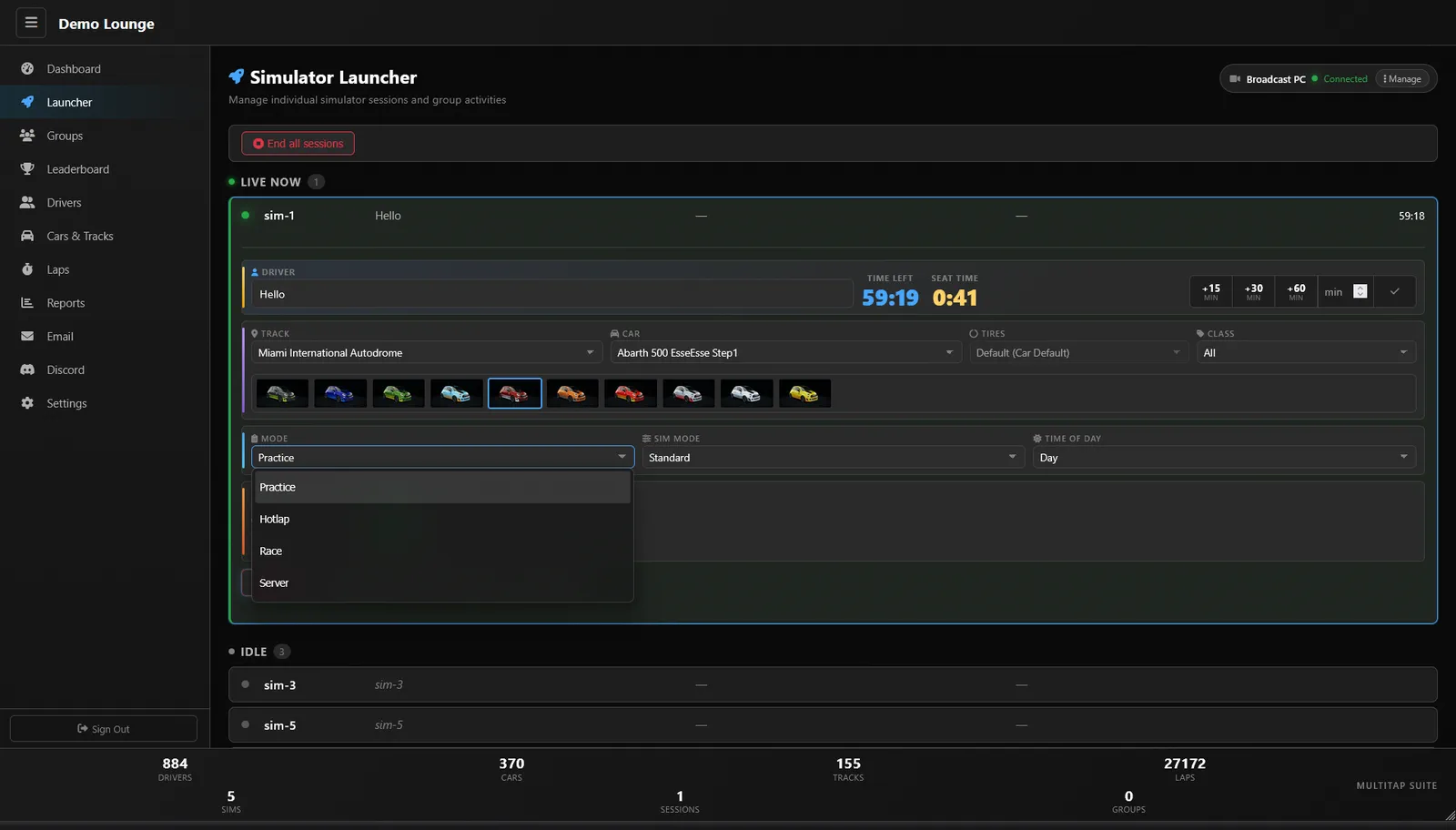
If you have searched ggLeap vs Multitap expecting a feature for feature cage match, the honest answer is that these two products are not aiming at the same room. ggLeap grew up managing PC esports centers. Multitap is sim racing center software that starts at the wheel instead of the counter. Operators still line them up against each other, usually because they are building a floor that has both kinds of seats and they want to know how many pieces of software they are about to sign up for. So here is the practical read: what each one is actually built to run, where the overlap really sits, and how to pick without buying twice.
What ggLeap is built to run
ggLeap, from ggCircuit, describes itself as esports venue management software. The core of it is point of sale, PC reservation booking and game license management, and it pairs with ggRock, their diskless boot and imaging platform. If your room is thirty gaming PCs and your daily problems are who is sitting at station 14, what they owe when they walk out, and how you get a large game update onto every machine before Friday night, that stack was designed for exactly those problems and it handles them.
The thing it was never designed around is a lap time. A sim racing session is not a timed seat rental with a game running on top of it. It is a car, a track, a sector split, a leaderboard position and a driver who wants to know whether they beat the time somebody set on Tuesday. Seat accounting does not capture any of that, and no amount of configuration turns billing minutes into a record board. There is a physical version of the same gap too, because a customer strapped into a wheel and pedals cannot reach a keyboard and mouse to navigate a launcher.
What Multitap is built to run
Multitap starts at the rig. Every sim runs a fullscreen Multitap client that customers navigate with the wheel, the paddles or a button box, with Windows hidden behind it and bindings customizable per venue. Nobody needs a keyboard, and nobody needs a staff member standing over the seat to start the session.
From there the platform is built around what the lap is worth to you. Laps are captured and pushed to your in-venue leaderboards with per-track and per-car splits, in-venue broadcast displays and a public web URL for the venue. Group races, solo hotlaps, structured practice and fully custom servers all launch from one admin surface. Traffic dodging runs NoHesi style on a locally hosted server, so several drivers weave through AI traffic together with their own scoring and their own boards. The broadcasting feature joins group races on its own and cycles through per-track camera presets you set once, so the spectator TVs look directed without anyone directing them. A live lap editor lets you invalidate a dirty lap before it sticks to your record board. All of it is on the features page.
Then there is the part that runs after the customer leaves, which is where general venue platforms usually stop. Multitap treats every lap as a reason to talk to that driver again, with automated email after sessions, leaderboard updates, and a Discord bot that posts lap personal bests, traffic high scores and race results into your venue server as they happen. On the SaaS plan, laps also sync to the TAPPED IN global leaderboards with public driver profiles, so a regular is chasing a ranking that follows them rather than just the best time in your building.
Be clear eyed about scope in both directions. Assetto Corsa support is complete, Assetto Corsa Competizione and iRacing are covered for leaderboards, and Automobilista 2, rFactor 2 and Assetto Corsa Evo are planned rather than shipped. Multitap also does not bundle a point of sale, kiosks or payments, which is a real difference from ggLeap and a deliberate one. The assumption is that you already run something you trust at the counter.
The overlap is smaller than the search implies
Line the two up and the shared ground is thinner than the comparison suggests. Both are the software your staff opens to get a customer playing, and both answer some version of who is on which machine right now. After that they diverge completely. ggLeap optimizes the transaction, the seat and the game library. Multitap optimizes the session outcome and what you do with it afterward.
That means the real question is not which one wins. It is which of your problems is the expensive one this year. If checkout is chaos and game updates eat your Thursday, buy the platform that fixes checkout and imaging. If your Saturday sells out and your Tuesday is empty, the software that fills Tuesday is worth more than the software that rings up Saturday, because a leaderboard chase and a post-session email are what pull a driver back midweek.
Mixed floors: PCs on one side, rigs on the other
A lot of US venues are not purely one thing. There is a bank of gaming PCs along one wall and four to eight racing rigs in the back, and the two halves genuinely behave differently. The clean way to think about it is by seat type rather than by vendor. PCs are a seat and inventory problem, so a PC center platform is the right shape for them. Rigs are a session and leaderboard problem, so racing software belongs on those.
Because Multitap does not try to own your counter, running it on the racing side does not force you to rip out whatever handles the PC side. If you want the two talking to each other, API access is part of the SaaS plan, which is marked coming soon, while the self hosted build deliberately does not include it. That is a real constraint worth checking against your plans before you choose a deployment model rather than after.
What Multitap costs, and how to decide
Self hosted is available now at a $6,000 one-time fee, forever, with no subscription and unlimited sims. You get a white-glove install, ultra-low latency on your own LAN and an optional 24/7 support add-on. The trade is that there is no API access, no remote launching and no global TAPPED IN leaderboards. It suits mobile trailers and venues that cannot live with a round trip to US servers.
The flagship SaaS plan is coming soon at $45 per sim per month as intro pricing for the first six months, then $65 per sim per month. That plan includes API access, remote launching from any device, TAPPED IN global leaderboards and support, and it is self-install with no scheduled install window. Volume discounts start at 8 or more sims, and the full breakdown sits on the pricing page.
The useful way to run that math is over three years instead of three months, weighed against how many extra midweek sessions an automated email and a leaderboard chase actually pull in. If you want to judge it without a sales call, the live demo is open at demo.mlttp.com with the login printed on the Multitap homepage, and NXT LVL Gaming in Miami runs Multitap on a real floor, written up in full in the NXT LVL Gaming case study. Otherwise tell me about your venue on the inquiry page and I will come back to you, usually within 24 hours.
See Multitap in Action
Lap-triggered marketing, TAPPED IN, and the Discord engine, live and unscripted. Try the public demo or book a walkthrough.
Make an Inquiry →