Ask most owners how the venue is doing and you get a monthly number back. That is the wrong resolution to look at. A sim racing floor makes or loses its money in the four or five hours on a Friday and Saturday night when every rig could be full, and the difference between a healthy room and a struggling one is how many of those hours actually got sold. Sim racing venue ROI is decided in that window, not in the monthly summary.
So here is the operator view of a busy floor: the math that matters, how long a session should really be, and the habits that decide whether your rigs sit warm or sit idle between drivers.
Sim Racing Venue ROI Comes Down to the Rig Hour
Your capacity on any given night is easy to work out. Take your rig count and multiply it by the hours you are open. Eight rigs from six until midnight is 48 rig hours on the board, and every dollar you put into cockpits, PCs, the lease and your software is being paid back out of those units. That leaves two questions worth tracking: what share of them you sold, and what each one earned you.
Log that by night of the week for a month and the picture usually gets uncomfortable quickly. Saturday evening is close to full, Tuesday is thin, and both nights quietly leak capacity in the minutes between one driver getting out and the next one strapping in. Those are two completely different problems. Thin Tuesdays are a demand problem you solve with marketing and formats. A full Saturday that still underperforms is a throughput problem, and throughput is the cheaper of the two to fix because you already have the customers standing in the room.
One more thing about the software line in that equation. It is a fixed cost that does not care how busy you are, so its effect on your return is entirely about how many extra rig hours it helps you sell. Our pricing works the same way in both models: Self Hosted is a one-time $6,000 fee with unlimited sims, and the SaaS plan, which is coming soon, is $45 per sim per month for the first six months and $65 after that. Spread either one across a year of Saturday nights and the per-rig-hour cost is small. The hours you never sold are the expensive part.
Pick a Session Length and Defend It
Session length is the most underrated pricing lever in the building. Short sessions turn the floor over faster and get more people through the door on a busy night, but they also cut the time a first-timer needs to stop fighting the wheel and start enjoying themselves. Long sessions feel generous and produce better laps, and they also mean a queue by the door watching eight people have a great time without them.
There is no universal right answer, but there is a right way to decide. Pick your busiest night, watch what people actually do with the time, and notice when they stop improving and start checking their phone. Then set your standard slot, put it on the wall, and hold it. The floors that struggle are usually the ones where the slot is whatever the staff feels like that evening, because that is the version customers complain about and the version you cannot forecast.
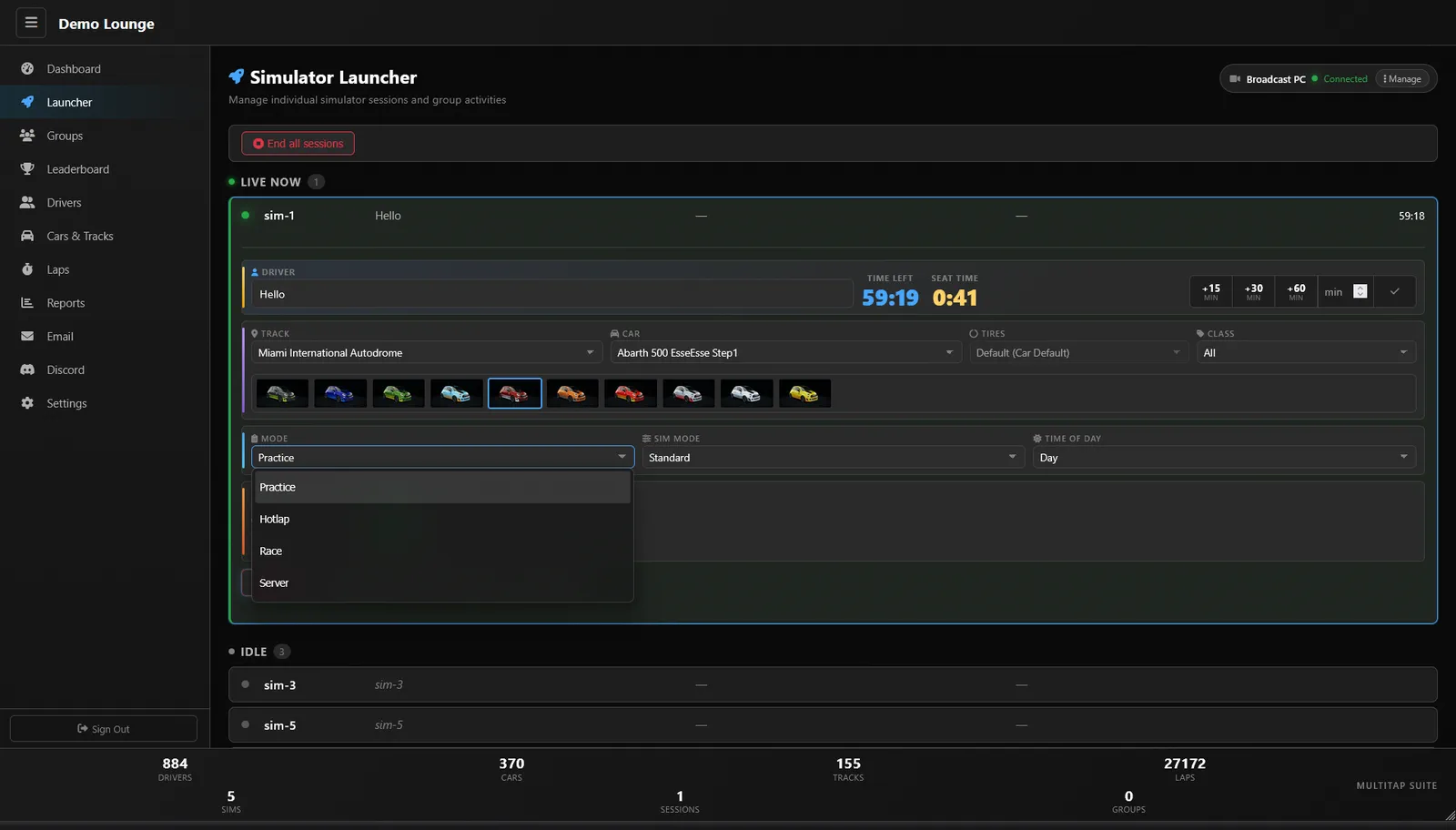
Formats help here more than pricing tweaks do. A structured group race has a natural end that nobody argues with, and so does a hotlap block with a leaderboard on the wall. Our race modes cover group racing, practice and hotlaps, traffic dodging and custom servers from one admin surface, which means the format you pick for a busy night is a setting rather than a project. Sessions that end on their own terms are easier to run than sessions somebody has to walk over and interrupt.
Kill the Dead Minutes Between Drivers
Here is where most floors lose the hours they never notice losing. A driver climbs out, a staff member walks over, alt-tabs out of the game, clicks through a desktop, picks a car and a track for the next person, then explains the menus. Call that six or seven minutes. Do it four times a night on eight rigs and you have quietly given away a chunk of your busiest evening for free.
Two things fix it. The first is presets, so starting the next session is one action instead of a sequence of them. The second is getting the desktop out of the way entirely. Every sim on Multitap runs a fullscreen client where customers navigate with the wheel, paddles or a button box, Windows stays hidden, and the bindings are set per venue. That removes the most common reason staff get pulled to a rig in the first place, which is somebody staring at a menu that was never designed for them.
Leaderboards do quiet work in the same window. Laps land on the in-venue boards as they are set, so the person waiting has something to watch and the person finishing has a reason to book again. A screen that turns waiting into part of the experience is worth more on a Saturday than another sign about your hourly rate.
Give Everyone on the Floor One Job
Staffing a busy night goes wrong when three people are all doing a bit of everything. Split it instead. One person owns the door and the queue, which means knowing the real wait, taking payment and setting expectations before anyone gets annoyed. One person owns the rigs, walking the line, getting new drivers seated and belted, and handling the one wheel that always needs a re-center. On your biggest nights a third person owns the room itself: the broadcast screens, the group race start, and the noise that makes a full floor feel like an event.
That last role is the one people cut first and should not. Our auto-spectator joins group races on its own and cycles through camera angles you set up once per track, so the feed on your TVs does not need a human running it. That frees the person who would have been operating a camera to do something that actually earns money, like getting the next group seated.
Worth saying plainly: none of this is booking software. How you take reservations is a separate decision with its own tradeoffs, and we wrote about walk-in, reserved and hybrid floors if that is the part you are still working out. What happens after somebody walks through the door is a different layer, and it is the layer that decides whether a full room converts into a good night.
Start With One Saturday
You do not need a spreadsheet overhaul to get going. Pick one busy night, count your rig hours, count how many you sold, and time three changeovers with your phone. Whatever that comes to, the gap between it and a full board is the most honest number in your business, and it is usually a lot easier to close than finding new customers.
If you want to see how the launcher, session presets and leaderboards handle a packed floor, book a walkthrough and we will run it on real hardware with real data. You can also drop in at NXT LVL Gaming in Miami and watch Multitap run a live venue on a busy night, which is usually more convincing than any demo call.
See Multitap in Action
Lap-triggered marketing, TAPPED IN, and the Discord engine, live and unscripted. Try the public demo or book a walkthrough.
Make an Inquiry →